In order to better understand cloud structures more than 60 scientists from the Max Planck Institute for Meteorology (MPI-M) and the Laboratoire Météorologie Dynamique (LMD), France, classified ten thousand satellite images into four types of organization. They now challenge interested people in a competition to join and build a machine learning algorithm that automates the detection of cloud patterns.
Aircrafts have long been used to sample clouds, now the German research aircraft HALO (High-Altitude LOng-Range) has been configured as a mobile cloud observatory.
In a new study published in the Journal of the Atmospheric Sciences Dr Claudia Stephan and Dr Hauke Schmidt from the department “The Atmosphere in the Earth System” at the Max Planck Institute for Meteorology (MPI-M) together with scientists from Forschungszentrum Jülich and the German Meteorological Service (DWD) present the first intercomparison of resolved gravity wave momentum flux (GWMF) in global convection-permitting simulations and those derived from satellite observations. Increasing…
Stratocumulus clouds are efficient in cooling the Earth’s atmosphere by reflecting incoming solar radiation back to space. However, predicting the lifetime of stratocumulus clouds remains a challenge and one important reason for that is the limited understanding of how stratocumulus clouds mix with the free-tropospheric air above them.
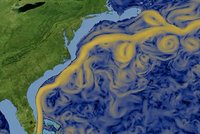
The Max Planck Institute for Meteorology (MPI-M) has a long tradition of creating general circulation models of the ocean in order to pursue its scientific goals. These models rest upon fundamental physical principles such as Newton’s second law and conservation of mass. The numerical modelling consists of discretizing the ocean’s dynamical equations and to solve them on modern supercomputers. In the following the history and development of ocean modelling at MPI-M is summarized.
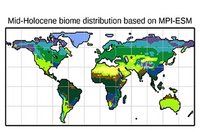
In a new study published in Climate of the Past and highlighted by the journal, Anne Dallmeyer, Victor Brovkin and Martin Claussen from the department "Land in the Earth System" at the Max Planck Institute for Meteorology (MPI-M) have developed a method to uniformly "biomize" vegetation distributions calculated by Earth System models, i.e. to convert the vegetation into macroecosystems (biomes).
On the subject of facts as a political issue. Discussing science under pressure, talk Prof Volker Heinz from the Institute of Cultural Studies in Essen, Prof Jochem Marotzke, Director at the Max Planck Institute for Meteorology in Hamburg and Prof Diethard Tautz, Director at the Max Planck Institute for Evolutionary Biology in Plön.
Scientists from the department "The Ocean in the Earth System" at the Max Planck Institute for Meteorology (MPI-M) have shown in the Journal of Advances in Modeling Earth Systems why the Atlantic Meridional Overturning Circulation (AMOC) slows down significantly when the resolution for the atmosphere in the Earth System Model of the MPI-M (MPI-ESM) is increased.
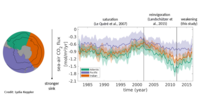
In a new study, Lydia Keppler and Dr Peter Landschützer from department “The Ocean in the Earth System” at the Max Planck Institute for Meteorology (MPI-M) find that the carbon dioxide (CO2) absorption in the Southern Ocean weakened between 2012 and 2016. The study links shifts in regional winds to this reduced carbon uptake.
Using extensive computer simulations, the scientists Dr Dirk Olonscheck, Dr Thorsten Mauritsen and Dr Dirk Notz from the Max Planck Institute for Meteorology (MPI-M) in Hamburg and the University of Stockholm are now able to explain why the Arctic sea ice varies greatly from year to year. Their results were recently published in Nature Geoscience.
In a new study in Geophysical Research Letters Dr Tatiana Ilyina and Dr Mathias Heinze from the department "The Ocean in the Earth System" at the Max Planck Institute for Meteorology (MPI-M) found that during the Paleocene-Eocene Thermal Maximum (PETM) changes in overturning circulation are key to reproducing the deoxygenation and carbonate dissolution record. The study was picked as a "Research Spotlight" in the journal EOS.
Beginning in May 2019 a new working group on cloud-wave coupling led by Dr Claudia Stephan has joined the department "The Atmosphere in the Earth System" at the Max Planck Institute for Meteorology (MPI-M). Claudia Stephan was awarded a Minerva Fast Track position by the Max Planck Society (MPG). MPI-M congratulates Claudia Stephan!




![[Translate to English:]](/fileadmin/_processed_/d/8/csm_Fig1_5cabdb68f5.png "[Translate to English:]")


![[Translate to English:]](/fileadmin/_processed_/e/2/csm_Claudia_Stephan_Portrait_b8957d8fc3.jpg "[Translate to English:]")