




Advances in Climate Modeling
Creating a modular digital twin of the cryosphere and terrestrial ecosystems
TerraDT is a project funded by the European Union through the Horizon Europe research program. It aims to enhance the infrastructure of the Destination Earth (DestinE) initiative, which develops digital twins—realistic virtual replicas—of the Earth, designed to address specific questions about the climate system. TerraDT focuses on the representation of Earth’s frozen regions (the cryosphere), the land surface, and aerosols in the ICON and IFS/FESOM Earth System Models. These developments are especially relevant for longer-term climate projections within DestinE and thus for the digital twin informing climate adaptation measures.
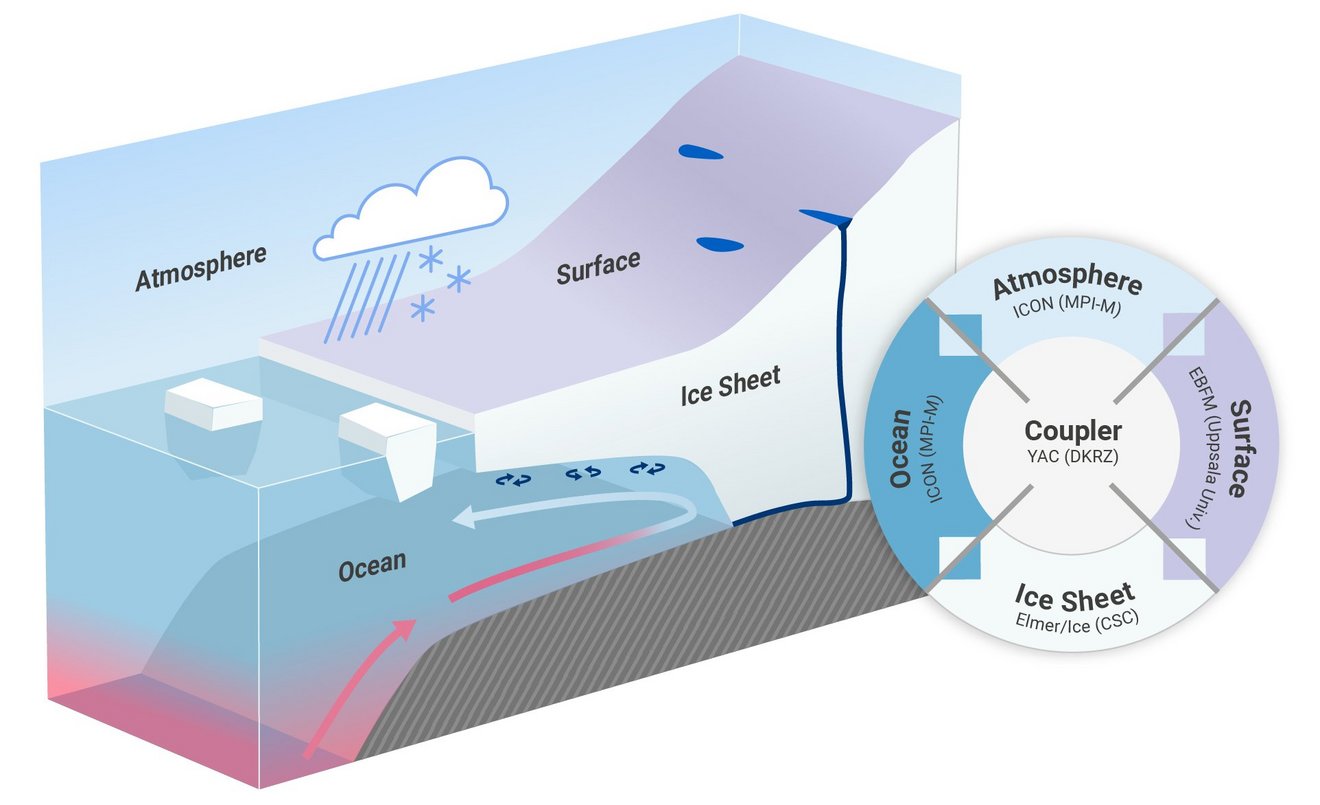
Within TerraDT, MPI-M and its partners aim specifically at facilitating the first-ever coupling of a state-of-the art land ice model (Elmer/Ice) to a km-scale climate model (ICON). The final goal of this endeavour is a tool that will help to better constrain the contribution of Earth’s big ice sheets to future sea-level rise. Typically, even the IPCC estimates of these contributions are based largely on the results from stand-alone land ice models that are driven with downscaled climate forcing from atmosphere-ocean climate models. This approach is neglecting potentially important feedbacks between ice-sheet melt, atmosphere and ocean circulations. Climate models coupled interactively with ice sheet models do exist, but are mainly used for paleo studies and run with coarse horizontal grids. However, the coarse grid scales used in this approach do not allow to represent fine-scale processes such as interactions between fjord terminating glaciers (relevant for the Greenland ice sheet), ocean cavities (relevant for the Antarctic ice sheet), and the surrounding oceans. Another motivation for km-scale ice-sheet climate modelling is better representation of orographic precipitation (rainfall related to the terrain), which impacts the surface mass balance of the large ice sheets.
TerraDT brings together a consortium of 18 institutions with expertise in Earth system modeling, supercomputing, and climate impact assessment, including the key partners involved in the digital twin for climate change adaptation as part of the Destination Earth project.


More Content

![[Translate to English:]](/fileadmin/04_Kommunikation/01_Aktuelles/2026/260505_ORCESTRA_Tellus/10_240923_ORCESTRA-24_Barbados_meteor-clean_tvo_FINAL_3318.jpg "[Translate to English:]")
From Fieldwork to the Literature: ORCESTRA Overview Paper Published
In 2024, the ORCESTRA field campaign examined cloud organization in the tropical Atlantic using three research aircraft, two ground stations, a…

Oceanographer Carl Wunsch Receives BBVA Award
The 18th Frontiers of Knowledge Award in the Climate Change and Environmental Sciences category goes to American oceanographer Carl Wunsch of the…