



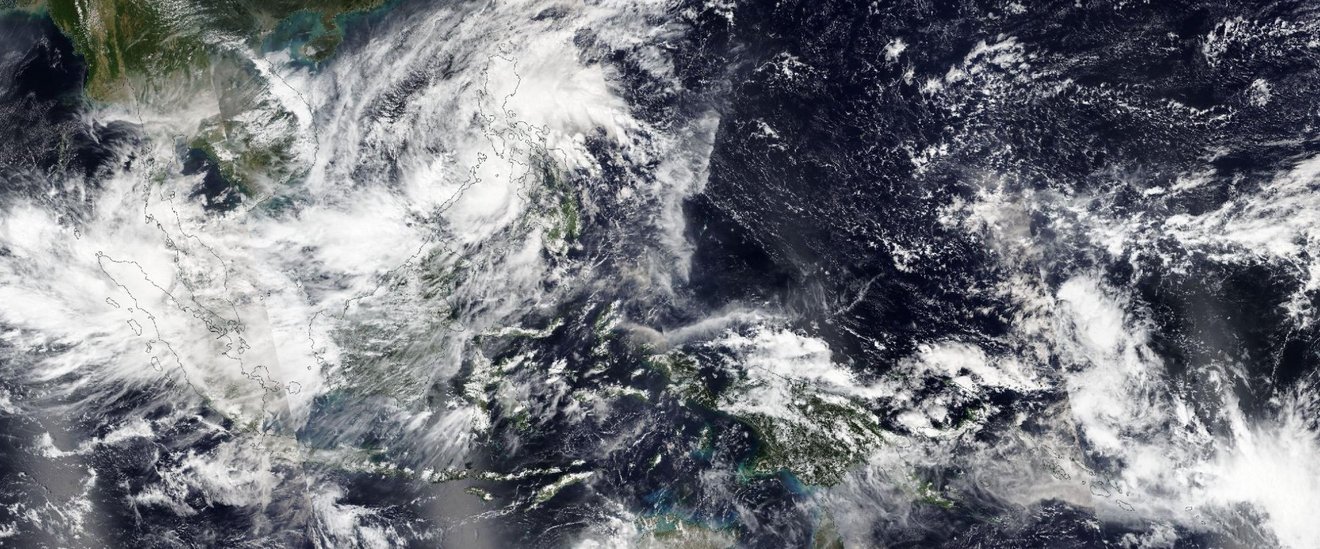
Our group studies the two-way interaction between small-scale weather processes and large-scale climate dynamics to better understand the Earth’s climate.
Weather describes the day-to-day or even hour-to-hour variability in atmospheric states: whether it is sunny, windy, or rainy at a particular location. Climate, on the other hand, describes the general averaged state of weather patterns over a longer period, such as the fact that the average temperature has been rising over the past few decades. In the context of global warming, weather is largely treated as a “slave” to the large-scale climate state, changing in response to it. However, it can also be interpreted in the following way: the statistical properties of weather establish the changing climate state.
One example is the interaction between moist convection and large-scale atmospheric circulation in the tropics. Although the Hadley Cells, the ITCZ, and the Walker Circulation appear to be consistent, gentle overturning circulations in annual means, they are maintained by intermittent and dramatic episodes of severe thunderstorms on an hourly-to-daily basis. Is the statistical behavior of convection controlled by large-scale constraints, or is it weather-scale dynamics that control large-scale circulation changes? Perhaps it is both — suggesting a cross-scale, two-way interaction.
To understand or even predict future climate change, it is essential to understand the cross-scale interaction between weather and climate. The developed high-resolution climate model at MPI-M, ICON, allows for such examination more explicitly. Our group currently focuses on the following topics:
Current focal points
-
What statistical behaviour do convection and vertical velocity exhibit when the large-scale Walker circulation changes under warming?
-
What physical processes drive such statistical changes in areas with different convective activity?

More Content


How can Thermokarst Lakes be Incorporated into Climate Models?
Thermokarst lakes are numerous and dynamic and play a significant role in the Arctic hydrology and climate. Until now, however, there has been no way…

New Research Group Led by Wei-Ting Hsiao Explores Weather-Climate Interaction
As of April 2026, Wei-Ting Hsiao is leading the new “Weather-Climate Interaction” research group at the Max Planck Institute for Meteorology. Within…